
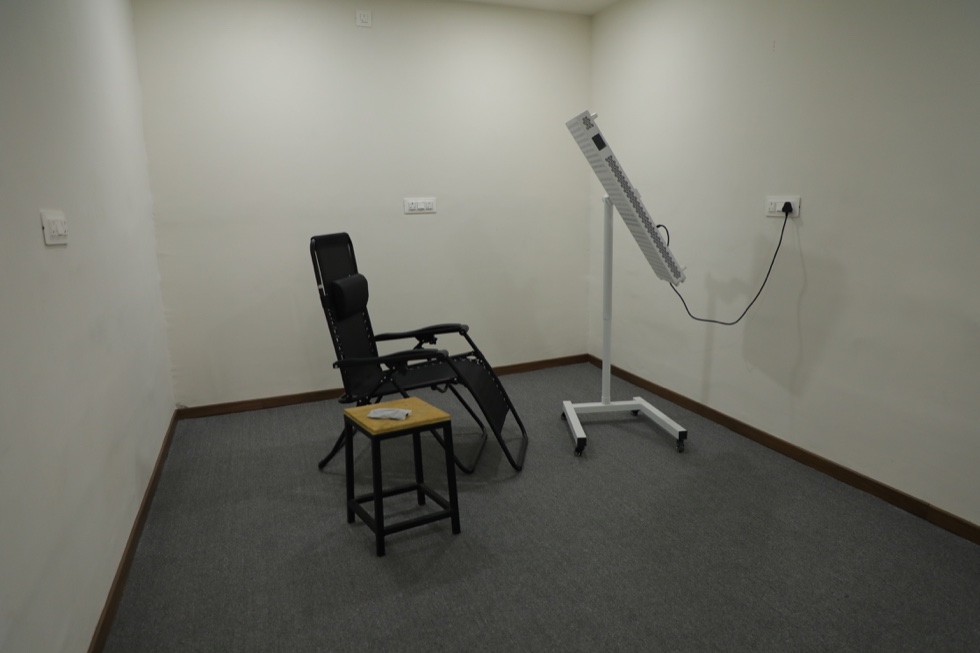
In our Sarjapur Road recovery area, a dedicated light panel sits beside a reclining chair. Researchers call the use of red or near-infrared light on tissue photobiomodulation. In sports studies, researchers have looked at whether it affects muscle fatigue, soreness and performance after exercise.
The evidence depends on the device
A review of targeted treatments found possible improvements in muscular performance or fatigue in some trials. A placebo-controlled training trial in already-trained participants found no additional improvement. A separate review of whole-body devices found limited evidence for exercise performance and recovery. Results from a device placed directly over a muscle are hard to translate to a panel used at a distance. Vanin et al., 2018 · Placebo-controlled training trial · Whole-body review.
What to check before a session
Targeted studies with positive results used wavelengths between 655 and 950 nm and a wide range of energy doses. The light reaching your skin also depends on the panel’s output, your distance from it and the exposure time. That is why there is no universal timer or distance to copy from a study. Review of wavelengths and doses.
Ask staff for the panel’s operating instructions and recommended distance and duration. Use any eye protection specified for the device, and avoid looking directly at the LEDs. If you take medicines that make you sensitive to light or have a light-sensitive condition, check with your clinician before using the panel.
Ask the Sarjapur Road team about access, the equipment settings and booking a first session.